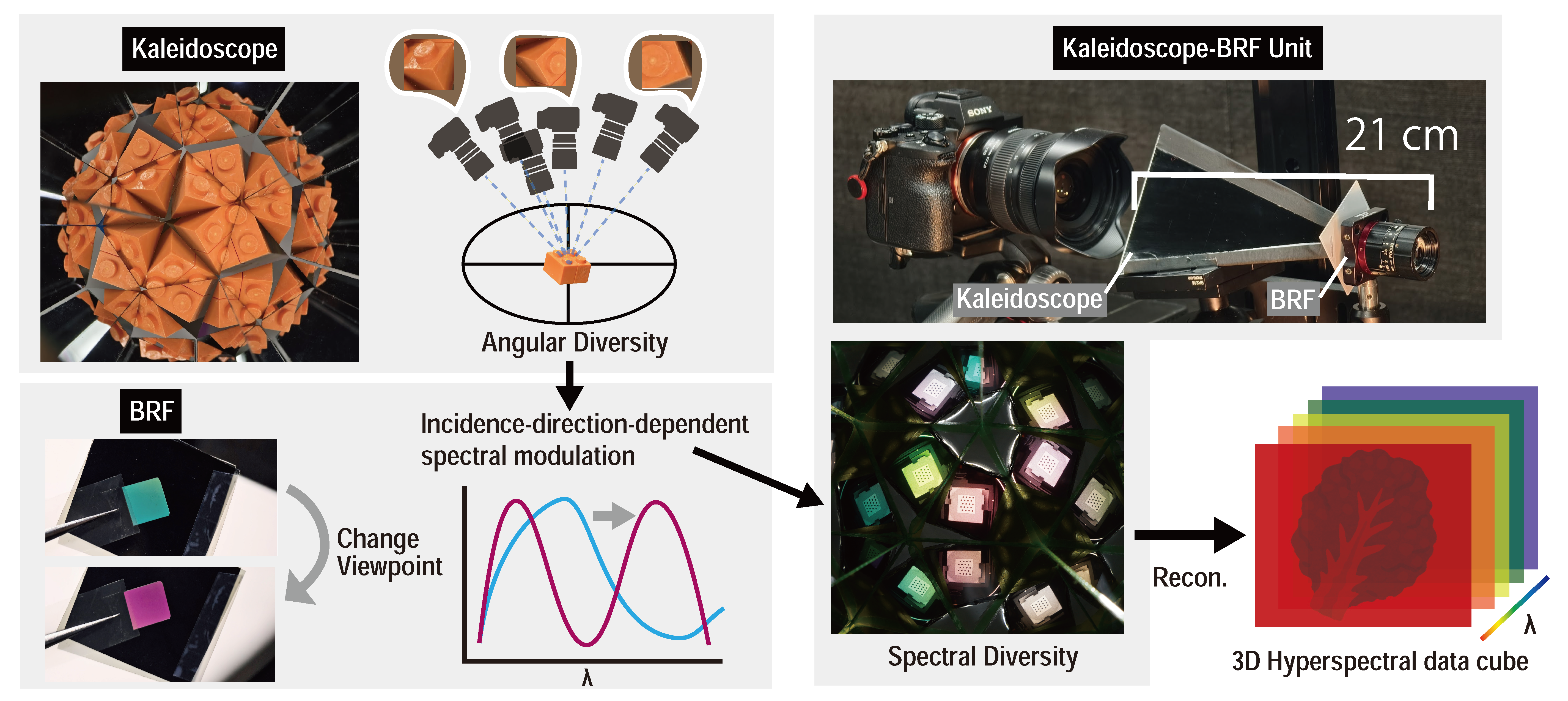
Snapshot hyperspectral imaging avoids sequential scanning, but systems that jointly achieve stable reconstruction, low cost, and compact optics remain limited. We present a snapshot hyperspectral imaging system based on angular-to-spectral diversity conversion. A tapered kaleidoscope creates replicated views with distinct incidence directions, and a directly attached birefringent filter converts them into view-channel-dependent spectral transmittances, yielding complementary measurements that better condition the inverse problem for more stable single-shot spectral reconstruction. The system preserves a simple pixel-wise linear model for fast non-learning-based reconstruction and uses only off-the-shelf components without relay optics or cascaded modules. We select the birefringent filter configuration using a condition-number-based criterion and validate the system on both synthetic and real data.
Compact Low-Cost Hyperspectral Imaging
via Angular-to-Spectral Diversity Conversion
ECCV 2026
1Nara Institute of Science and Technology
2Kyoto University
Abstract
21 cm
compact add-on
25 bands
spectral reconstruction
430–670 nm
spectral range
No learning
pixel-wise inverse solver
System Overview
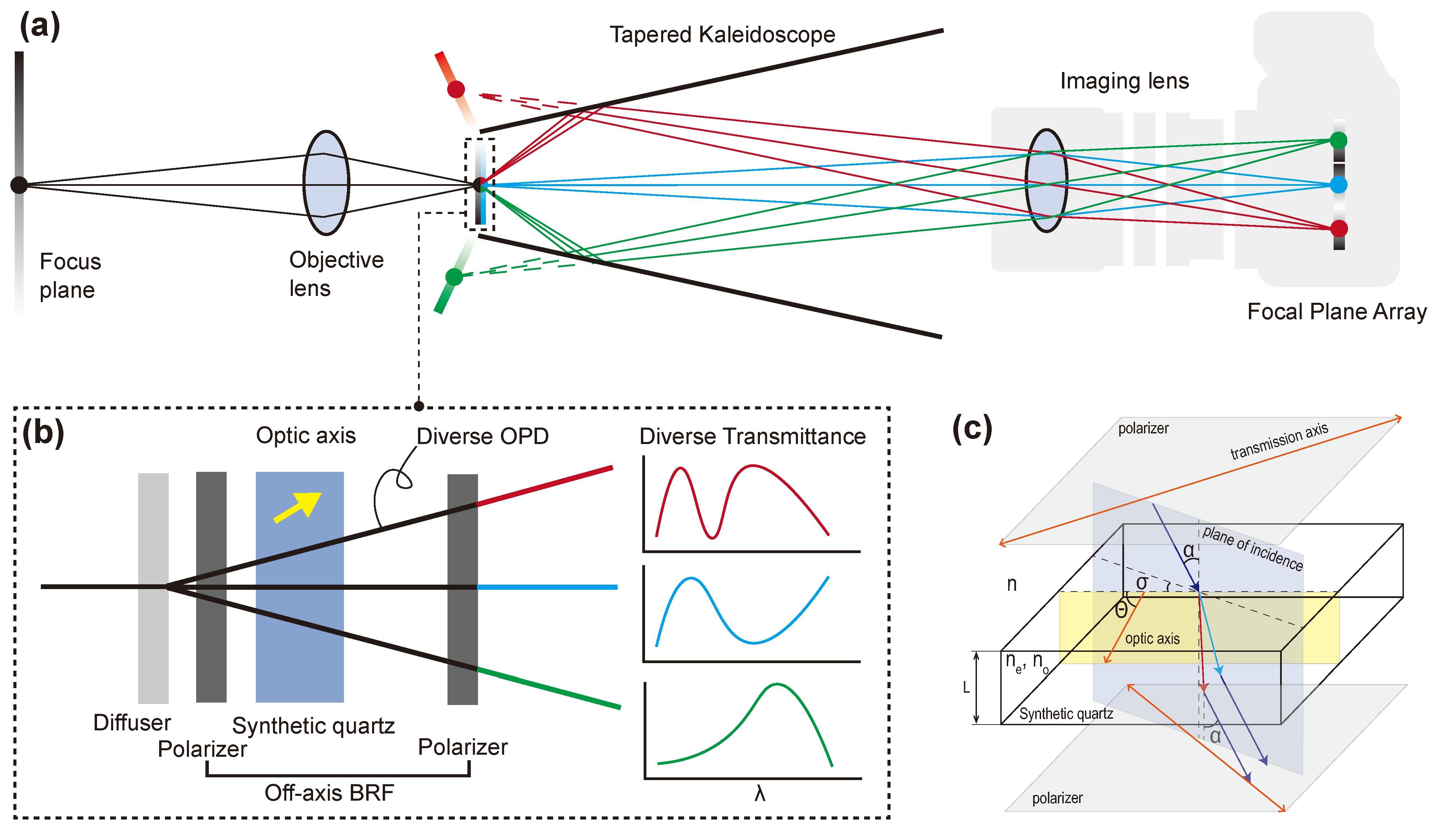
Our system converts angular diversity into spectral-response diversity in a compact optical add-on. A tapered kaleidoscope generates multiple replicated views, and a birefringent filter modulates each view differently depending on incidence direction. These complementary measurements are then used to reconstruct the hyperspectral cube.
01
Replicate views
The tapered kaleidoscope produces multiple views of the same scene
with different incidence directions.
02
Convert angle to spectrum
The birefringent filter changes its spectral transmittance with
incidence direction, creating complementary spectral measurements.
03
Reconstruct the cube
Registered measurements are combined through a simple pixel-wise
linear model to recover 25-band hyperspectral data.
Results
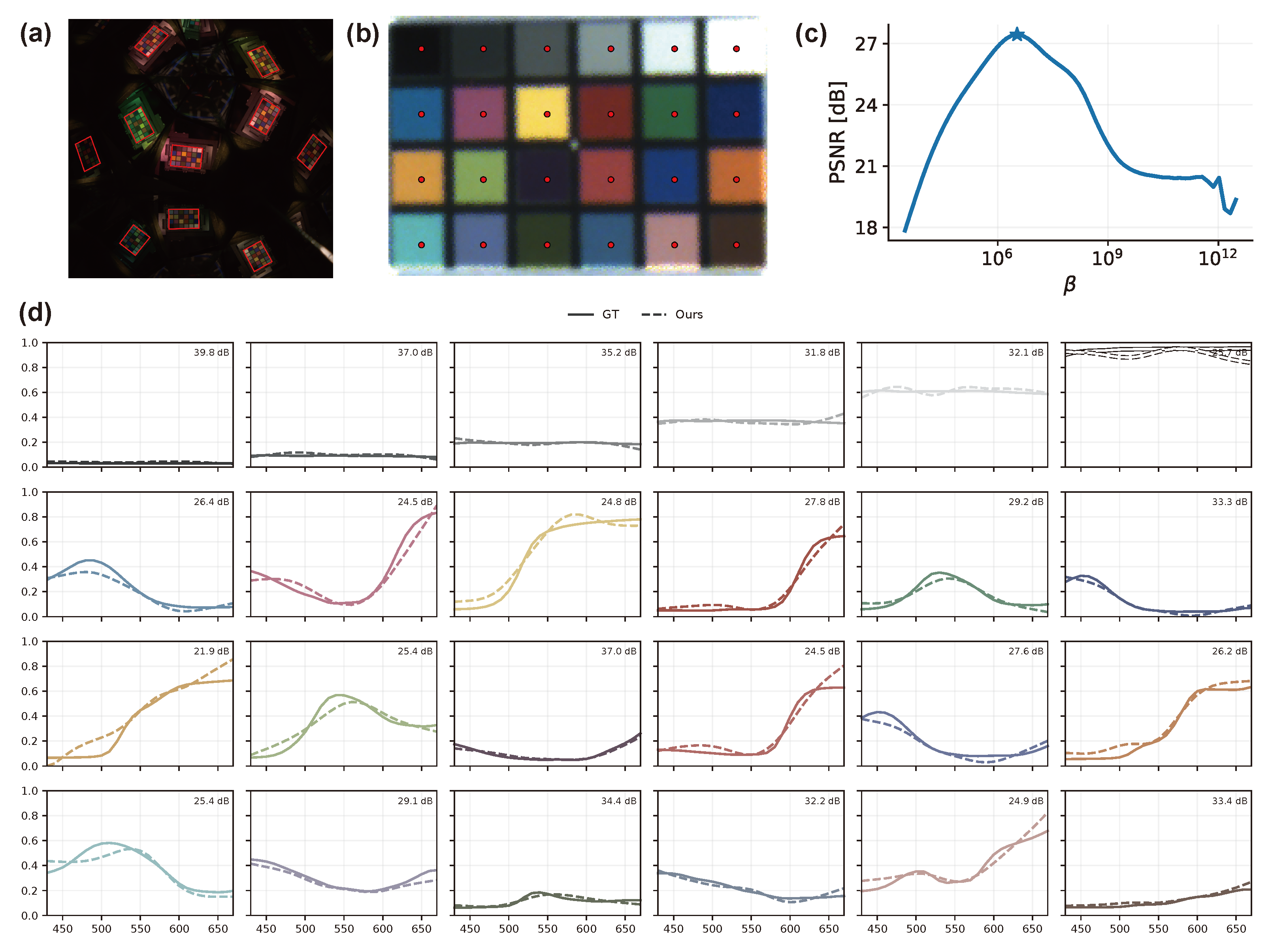
ColorChecker Validation
Real-data reflectance reconstruction over 25 bands from
430 nm to 670 nm. The reconstruction achieves 27.4 dB PSNR
over all 24 patches and wavelengths.
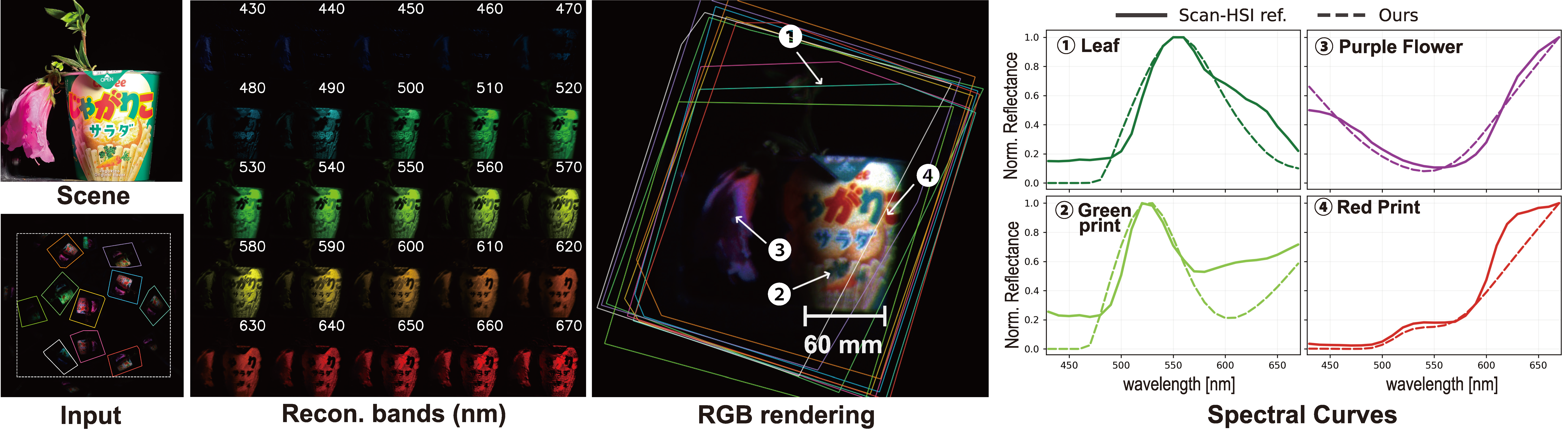
Real-Scene Reconstruction
A leaf, flower, and printed materials are reconstructed using
the same prototype and reconstruction pipeline, showing
material-dependent spectral variation in a non-flat scene.
BibTeX
@InProceedings{Kazuma2026A2SHSI,
author="Fujiwara, Kazuma
and Funatomi, Takuya
and Kitano, Kazuya
and Fujimura, Yuki
and Mukaigawa, Yasuhiro",
editor="Favaro, Paolo
and Kukelova, Zuzana
and Maki, Atsuto
and Rohrbach, Anna
and Schindler, Konrad
and Tombari, Federico",
title="Compact Low-Cost Hyperspectral Imaging via Angular-to-Spectral Diversity Conversion",
booktitle="Computer Vision -- ECCV 2026",
year="2026",
publisher="Springer Nature Switzerland",
address="Cham",
pages="589--606",
isbn="978-3-032-37196-6"
}